Toyota in the News
Toyota in the News was a great website for Toyota enthusiasts. What could you dislike about a website that allowed greater insight into the newest ​Toyota cars being introduced to the marketplace. Many of my salesmen budddies and I would sit around after a busy morning contacting and pitching potential clients wholesale janitorial supplies and kibbitz during our lunch break about the newest Toyota models. Then I'd be back on the phone taking orders from clients who needed bulk orders of major brand dish soap & dishwashing detergents, specifically eco friendly detergents and the accompanying dispensers or other janitorial supplies. Then when six o'clock came around our Toyota discussions would continue at the local bar where we always stopped for a beer before heading to our respective homes. This site gave me a distinct advantage over some of my fellow workers who weren't familiar with the Toyota News site. For a while there, I was the Toyota guru to my fellow workers. Of course today with smart phones being ubiquitous, everyone can stay on top of the car news whether it is Toyota or some other manufacturer.
2011 News Posts
Toyota has become a remarkable company, offering high-quality vehicles that are increasingly in-demand by consumers. With all the changes affecting the automotive industry in recent years, from gas price hikes to a dwindling sales in North American and in Japan, Toyota has remained strong thanks to its incredible lineup of reliable compacts and ultra fuel efficient hybrids.
At Toyota in the News, Toyota enthusiasts will be able to gain insights into Toyota news, get the latest information on new Toyota cars, trucks, and SUVs, and also gain information about Toyota dealers across the country.
+++
Toyota Adds Safety Tech To The 2012 Sequoia
by TOYOTA IN THE NEWS on OCTOBER 4, 2011
The full-size Toyota Sequoia is one of the best vehicles for towing, which is why Toyota has added new technology to the 2012 model to make this task safer.
The 2012 Toyota Sequoia will receive enhanced towing safety with the addition of a Blind Spot Monitor available on Sequoia Platinum. This system will warn drivers of vehicles that are traveling in their blind spots.
Additionally, the Sequoia will get Trailer Sway Control for the 2012 model year, a system that uses the Vehicle Stability Control (VSC) to help counteract handling forces acting on the truck in an effort to minimize the impact of trailer sway.
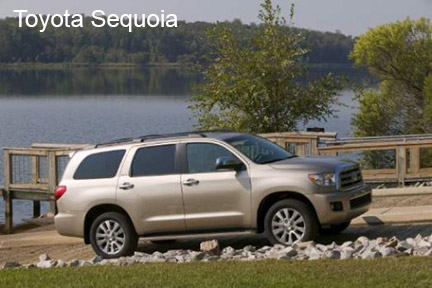
These systems are crucial for this SUV, which now features a 7,400-lb. towing capacity. This vehicle will also boast a standard 310 horsepower 4.6-liter i-Force V8, as well as an optional 381 horsepower 5.7-liter V8 engine.
Like the outgoing model, the 2012 Sequoia will also receive a bevy of comfort and convenience features, undoubtedly making family road trips a little easier. Available features include:
- Power tilt/slide moonroof
- Heated front leather-trimmed seats
- Second- and third-row retractable sunshades
- Steering wheel that integrates controls for the air conditioning system, Bluetooth-capable phones and other functions
- Auto-dimming electrochromic rear-view mirror
- 3.3-inch monitor in the rear-view mirror for the backup camera (when not equipped with a navigation system)
- JBL Synthesis AM/FM six-disc CD changer system with 14 speakers, SiriusXM Satellite Radio with a 90-day trial subscription, Bluetooth technology and an auxiliary audio jack/USB port.
For more information on the updated 2012 Toyota Sequoia, see your local Toyota dealer.
+++
Advanced Toyota Tech Goes On Display
by TOYOTA IN THE NEWS on OCTOBER 3, 2011
Toyota will exhibit its unique biotechnology and greening technologies in Aichi, Japan this month, hinting at what could become commercialized in just a few years. Technologies include cellulosic ethanol yeast, smart green parking and smart green walls.
Toyota has long been committed to reducing CO2 emissions, which is what led to the development of cellulosic ethanol. The automaker used gene recombination technology to develop a new strain of yeast that will play an important role in the fermentation process for producing cellulosic ethanol. In addition to developing renewable energy sources such as bio-fuels, Toyota is also working to develop next-generation environment-friendly vehicles.
Ultimately, TMC plans to further improve bio-fuel production yield and to cooperate with energy companies to realize its goal of commercializing cellulosic ethanol by 2020.
Additionally, Toyota has introduced its “cool-spot creation technology” for simulating the effects of greening and predicting the cooling effects of shade and transpiration created by trees. This will allow for a visual simulation of greening effects that can determine the types, numbers, and positioning of trees needed to achieve the desired cooling effect.
With its unique technologies, Toyota is hoping to promote and build low-carbon houses and cities.
+++
Toyota Unveils Tacoma TRD T|X Baja Series Limited Edition
by TOYOTA IN THE NEWS on SEPTEMBER 30, 2011
For hardcore off-roading enthusiasts, your new truck has finally arrived. Toyota has unveiled its Tacoma Toyota Racing Development (TRD) T|X (Tacoma Extreme) this week at the 2011 Texas State Fair. The truck combines Toyota’s Baja racing heritage with the Tacoma’s legendary ruggedness.
This limited-edition features plenty of heavy-duty gear like an electronically-controlled locking differential, TRD off-road package with Bilstein race shocks and an increased ride height of two inches, BF Goodrich T/A KO tires and bead-lock style wheels. Power for this model exclusively comes from Toyota’s potent 4.0-liter V6 engine, and buyers can choose between a six-speed manual or five-speed automatic transmission.
+++
Scion iQ Ready For October Debut
by TOYOTA IN THE NEWS on SEPTEMBER 29, 2011
Putting big-time style in a small-sized package, the all-new 2012 Scion iQ premium micro-subcompact is scheduled to go on sale in October with an MSRP of $15,265. The striking iQ is a city-friendly 10 feet in length—more than two feet shorter than a MINI—but will leverage several engineering innovations to provide “the functionality and comfort that drivers expect from a car twice its size,” according to Scion.
These include a compact, front-mounted differential; a high-mounted steering rack (with electronic power steering); a compact air-conditioning unit; a flat gas tank housed beneath the car’s floor; “slim-back” front seats; and “3+1” offset seating that provides space for an adult sitting behind the front-seat passenger and room for a child or cargo behind the driver. Thanks to these unique features, the iQ will be the smallest four-seat car available in the U.S.
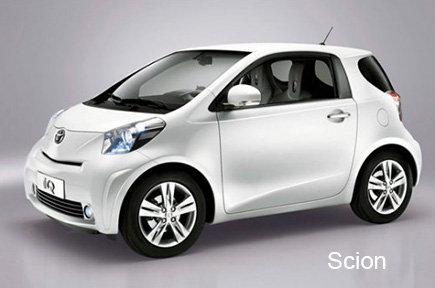
And there’s also room for a wide range of standard equipment, such as:
- 11 airbags, including Scion’s first driver- and front-passenger seat-cushion airbags
- A peppy and responsive 1.3-liter I4 engine that makes 94 hp and 89 lb.-ft. of torque
- A 160-watt AM/FM/CD/HD/USB audio system with streaming audio capability
- Eye-catching exterior design
- A leather-wrapped, flat-bottomed steering wheel with integrated audio controls
- Advanced suspension setups with MacPherson struts in the front and a compact torsion-beam rear suspension
- Seven bold exterior colors—Blizzard Pearl, Classic Silver Metallic, Magnetic Gray Metallic, Black Sand Pearl, Hot Lava, Pacific Blue Metallic and Black Currant Metallic
“Scion prides itself on being an innovative brand with a lineup of iconic vehicles that set automotive trends,” said Jack Hollis, vice president of Scion. “The iQ is the fourth vehicle in the family, and it will define the premium micro-subcompact segment as the choice for new urbanites who want clever transportation without a sacrifice in style or new features.”
+++
Toyota Venza Gets Three-Grade Model Line For 2012
by TOYOTA IN THE NEWS on SEPTEMBER 28, 2011
While Toyota’s lineup continues to offer an assortment of crossovers and SUVs, the Venza still delivers a unique combination of sportiness and versatility. For 2012, the Venza will also get a new three-model grade line to give customers even more to choose from.
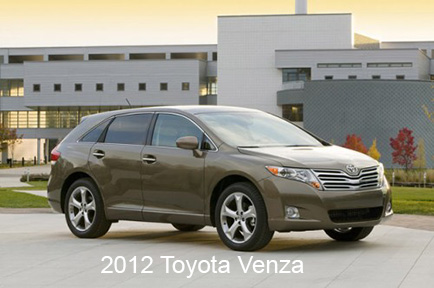
Buyers will be able to get the 2012 Toyota Venza in either LE, XLE, or Limited grades. The LE and XLE models are available with all powertrain combinations including four-cylinder, V6, front-wheel drive (FWD) or all-wheel drive (AWD). The range-topping Venza Limited comes with the V6 engine only, but offers the choice of front-wheel drive or all-wheel drive configurations.
+++
Toyota Honored As A “Best Company For Diversity”
by TOYOTA IN THE NEWS on SEPTEMBER 27, 2011
For the sixth consecutive year, Toyota’s dedication to diversity has been honored by Black Enterprise—the team behind the prestigious Black Enterprise magazine—which has again named the automaker to its 2011 roster of 40 Best Companies for Diversity. This year, Toyota earned its spot on the annual list specifically for its achievements in the area of supplier diversity.
“The companies selected for distinction in this list not only demonstrated a commitment to diversity, but viewed it as a business imperative,” said Sonia Alleyne, Black Enterprise Careers & Lifestyle editorial director. “The strength of Toyota’s network of minority suppliers enables the company to be even more competitive on a global scale.”
+++
Toyota Venza Gets Three-Grade Model Line For 2012
by TOYOTA IN THE NEWS on SEPTEMBER 28, 2011
While Toyota’s lineup continues to offer an assortment of crossovers and SUVs, the Venza still delivers a unique combination of sportiness and versatility. For 2012, the Venza will also get a new three-model grade line to give customers even more to choose from.
Buyers will be able to get the 2012 Toyota Venza in either LE, XLE, or Limited grades. The LE and XLE models are available with all powertrain combinations including four-cylinder, V6, front-wheel drive (FWD) or all-wheel drive (AWD). The range-topping Venza Limited comes with the V6 engine only, but offers the choice of front-wheel drive or all-wheel drive configurations.
What isn’t changing is the Venza’s fresh, modern design, which was the creation of Toyota’s Calty Design studios in Newport Beach, Calif., mad Ann Arbor, Mich. With the same footprint as a midsize sedan, it offers loads of interior space for passengers, while still offering plenty of maneuverability. Additionally, buyers will also appreciate the Venza’s SUV attributes, such as cargo space, towing capability and available all-wheel drive traction.
Powering the base 2012 Venza is a 182 horsepower 2.7-liter four-cylinder engine, which is rated at 27 mpg highway for the FWD model. A powerful 3.5-liter 268 horsepower V6 is also available. The latter delivers 19 mpg city and 26 mpg highway.
For more on the 2012 Venza, visit your nearest Toyota dealer.
+++
Toyota Honored As A “Best Company For Diversity”
by TOYOTA IN THE NEWS on SEPTEMBER 27, 2011
For the sixth consecutive year, Toyota’s dedication to diversity has been honored by Black Enterprise—the team behind the prestigious Black Enterprise magazine—which has again named the automaker to its 2011 roster of 40 Best Companies for Diversity. This year, Toyota earned its spot on the annual list specifically for its achievements in the area of supplier diversity.
“The companies selected for distinction in this list not only demonstrated a commitment to diversity, but viewed it as a business imperative,” said Sonia Alleyne, Black Enterprise Careers & Lifestyle editorial director. “The strength of Toyota’s network of minority suppliers enables the company to be even more competitive on a global scale.”
This latest recognition is further proof positive that Toyota’s “21st Century Diversity Strategy” is paying dividends for both the company and its team members. The program was launched in 2001 to set tangible diversity targets and is supported by a seven-member external advisory board helmed by Alexis Herman, former U.S. Secretary of Labor. Since Toyota implemented this effort, the company has more than doubled its spending with diverse suppliers and seen the number of people of color in its workforce grow to nearly 30 percent.
In addition, Toyota has been lauded for its diversity efforts by a wide range of other third parties:
- The automaker has been included among DiversityInc.’s Top 50 Companies for Diversity and the Human Rights Campaign’s Best Places to Work Corporate Equality Index for the past five and four years, respectively.
- In recognition of its spending more than $1 billion annually with certified ethnic- and women-owned suppliers, Toyota was inducted into the Billion Dollar Roundtable.
- It has also received both the Corporation of the Year award from the National Minority Supplier Development Council as well as the Distinguished Supplier Diversity Award from the Minority Business Development Agency.
“At Toyota, diversity and inclusion have always been among our top priorities, and we are honored to be recognized by Black Enterprise,” said Dian Ogilvie, senior vice president and chief diversity officer at Toyota Motor North America. “We believe constant growth towards a more inclusive environment is imperative not only in developing and retaining a talented workforce, but in fostering a corporate environment that mirrors the communities in which we do business. As we remain committed to continuously improving, we will work closely with our senior managers and Diversity Advisory Board to enhance our efforts even further.”
+++
Toyota, Ford To Partner On Next-Gen Hybrid Systems
by TOYOTA IN THE NEWS on SEPTEMBER 26, 2011
Two of the world leaders in hybrid technology for the auto industry—the Ford Motor Company and Toyota Motor Corporation—have announced they are joining forces to develop an advanced hybrid propulsion system for the next generation of light trucks and SUVs. The two automakers will work as equal partners in this important effort, with the new system is expected to debut before the end of the decade.
“By working together, we will be able to serve our customers with the very best affordable, advanced powertrains, delivering even better fuel economy,” said Ford President and CEO Alan Mulally. “This is the kind of collaborative effort that is required to address the big global challenges of energy independence and environmental sustainability.”
The new hybrid initiative builds on earlier, independent research from both companies, and will be aimed specifically at rear-wheel-drive applications. But note that, although the hybrid system is being built collaboratively, the current memorandum of understanding (MOU) between the two automakers calls for Ford and Toyota to “independently integrate the new hybrid system in their future vehicles separately”—in other words, don’t expect the vehicles themselves to share much more than the system itself.
“Toyota is extremely proud to join Ford in developing a hybrid system for pickup trucks and SUVs,” said Toyota President Akio Toyoda. “Not only is this tie-up clearly one aimed at making automobiles ever better, it should also become an important building block for future mobility in the U.S. By building a global, long-term relationship with Ford, our desire is to be able to continue to provide people in America automobiles that exceed their expectations.”
+++
Toyota Lowers Prices On 2012 Camry Lineup
by TOYOTA IN THE NEWS on SEPTEMBER 23, 2011
The Toyota Camry—the best-selling car in America for nine consecutive years—has been completely redesigned for the 2012 model year with more of just about everything—except for its price. Although MSRPs on V6 models remain unchanged, all high-efficiency four-cylinder 2012 Camry models except the base Camry L, which is primarily a fleet vehicle, showcase price reductions. And this includes the Camry Hybrid models:
- Camry LE, responsible for 60 percent of all Camry sales, will have an MSRP of $22,500, representing a $200 price decrease.
- The sporty Camry SE benefits from a $965 price cut and will begin at $23,000.
- Offering a wide range of premium amenities, the four-cylinder Camry XLE now starts at $24,725, a full $2,000 lower than in 2011.
- The base MSRP of the Camry Hybrid LE falls to $25,900, lower by $1,150 as compared to 2011.
- The up-level Camry Hybrid XLE will open with a starting price $800 below the 2011 model, at $27,400.
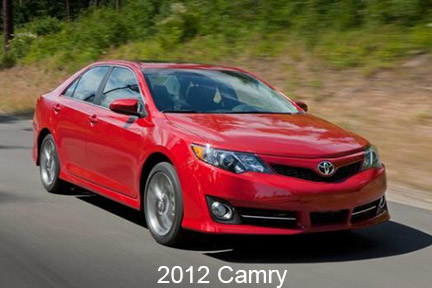
Then, to further bolster this new high-value pricing, Toyota upped content levels across the board. For example:
- Camry LE adds Toyota’s new Display Audio system, with a 6.1-inch touch screen and Bluetooth-enabled music streaming, and features remote keyless entry, auto on/off headlamps, chrome-accented side rocker panels, and steering-wheel-mounted audio and Bluetooth controls.
- New 17-inch alloy wheels, Display Audio, an aero body kit, sport-tuned suspension and steering, model-specific headlamps with black sport-trim bezels, chrome exhaust tips, leather interior accents, paddle shifters, heated outside mirrors, and unique sport seats are all now included with the Camry SE.
- For a more premium experience, the XLE builds on the comfort and convenience features of the SE and ups the ante with items like integrated chrome fog lamps, wood-style interior trim, dual-zone auto climate control with rear air vents and an eight-way power-adjustable driver seat.
As for the hybrid models, the big news is a 30 percent improvement in fuel efficiency, with the 2012 versions now capable of up to 43 mpg city/39 mpg highway/41 mpg combined—better than either the Ford Fusion or Hyundai Sonata hybrids.
Drivers can look for the all-new 2012 Toyota Camry to reach local dealerships in October of this year.
+++
2012 Toyota Camry To Pace Daytona 500
by TOYOTA IN THE NEWS on SEPTEMBER 22, 2011
The Toyota Camry already is the best-selling car in America, as well as the car with the highest level of U.S.-made parts, and it’s been built in this country for the past 25 years and counting. The next step in its transformation into a true American icon? The all-new Toyota Camry will be the pace car of the 2012 Daytona 500—the Great American Race.
“NASCAR and Daytona International Speedway provide a uniquely American platform for manufacturers to display their technology, innovation and overall automotive excellence,” said Daytona International Speedway President Joie Chitwood III. “After nearly eight years of competing at NASCAR’s highest level, I’m pleased to have the 2012 Toyota Camry pace the Daytona 500.”
And significantly, those eight years of experience have brought Toyota 36 trips to the winner’s circle in stock-car racing’s elite series, as well as 60 victories and three consecutive manufacturer’s championships in the Nationwide Series, and 88 wins and five straight manufacturer’s titles in NASCAR’s full-size pickup competition.
“We’re thrilled to be able to feature the new Camry in Daytona at the season’s biggest race,” said Ed Laukes, TMS corporate manager of motorsports marketing. “We think the Daytona 500 is the perfect place to showcase the all-new Camry. We knew when the opportunity arose to partner together with Daytona that it would be an extraordinary way to highlight our new Camry, as well as reinforce Toyota’s commitment to NASCAR and its fans.”
The completely redesigned Toyota Camry goes on sale this October and will set the pace at Daytona on Feb. 26, 2012.
+++
2012 Toyota Camry Hybrid Boasts Best-In-Class Fuel Efficiency
by TOYOTA IN THE NEWS on SEPTEMBER 21, 2011
Wearing the same sophisticated and 100 percent new sheet metal as the gas-only model, the 2012 Toyota Camry Hybrid sets a fresh benchmark for fuel-economy among mid-size hybrid sedans, delivering an EPA estimated 43 mpg city/39 mpg highway/41 mpg. That’s an improvement of more than 30 percent as compared to the 2011 model—and it now tops the performance of the Ford Fusion Hybrid, Hyundai Sonata Hybrid and Kia Optima Hybrid as well.
It’s the result of both significant weight reduction and aerodynamic improvements, along with a number of important upgrades to Toyota’s Hybrid Synergy Drive system. Among them: A new, more powerful 2.5-liter gas engine with intelligent variable valve timing and a new water-cooled exhaust gas recirculation system that also helps to reduce emissions. Thanks to these changes and more, the Camry Hybrid not only can achieve the already-mentioned EPA numbers, but it also provides drivers with 200 combined horsepower. Other upgrades for the new model year include:
- Improved sound insulation in the engine compartment
- More linear power delivery
- Enhanced efficiency measures for maintaining power to vehicle systems when the engine is off
- Newly optimized regenerative braking
- A more compact battery for extra trunk room
- Larger, 17-inch low-rolling-resistance tires
- A longer (1.6 miles) all-electric driving range at speeds under 25 mph
- But even with this comprehensive overhaul of the Camry Hybrid, Toyota has sliced a full $1,150 from its MSRP, which is now just $25,900—that’s $2,700 lower than the base MSRP of the Ford Fusion Hybrid.
The 2012 Camry Hybrid is slated to reach dealerships in October.